

Last Update 18 Jun 26
Fair value Decreased 0.40%SAN: Future Upside Will Hinge On AI Execution Across R&D Workflows
Sanofi's analyst price target has been revised slightly to €96.70 from €97.10. This change reflects updated views on its revenue growth outlook, profit margin assumptions and a modestly adjusted future P/E multiple, according to recent analyst commentary.
Analyst Commentary
Recent research on Sanofi is more limited than the number of reports currently focused on other European companies, but the small adjustment to the €96.70 price target still gives some insight into how analysts are framing the stock. The revised view on Sanofi reflects updated assumptions on revenue growth, profit margins and the future P/E multiple that investors may be willing to pay.
Bullish Takeaways
- Bullish analysts appear comfortable updating targets for large European stocks based on fresh revenue and margin work. This can support the case that Sanofi's revised target is grounded in ongoing fundamental reviews rather than a one off shift.
- The modest change in Sanofi's target suggests that, for some analysts, the stock's valuation still aligns reasonably with current earnings expectations and sector comparisons, instead of requiring a major reset.
- By explicitly revisiting profit margin assumptions, bullish analysts indicate that there is still room to fine tune models, which can be helpful for investors who focus on execution around cost control and product mix.
- The continued use of a forward P/E framework in setting Sanofi's target underlines that the stock is being assessed on its earnings power rather than short term sentiment alone.
Bearish Takeaways
- The reduction in the price target, even if small, signals that some analysts see less support for higher valuation multiples on Sanofi at this stage, which can limit upside if execution does not clearly outperform expectations.
- Adjustments linked to revenue growth assumptions show that not all analysts are fully confident in earlier top line expectations for Sanofi, and that there is some caution around how those assumptions feed into valuation.
- Revisiting profit margin forecasts can also reflect concern that cost pressures, product mix or pricing may weigh on profitability more than previously assumed, which in turn can cap the fair P/E level used in models.
- Because the target move is described as slight, more cautious analysts may view Sanofi as fairly valued around current assumptions, leaving less room for error if financial results or pipeline execution come in below expectations.
What's in the News
- US FDA granted accelerated approval for Sanofi's Tzield as the first disease modifying therapy for children aged 8 to 17 with recently diagnosed stage 3 type 1 diabetes, supported by the phase 3 PROTECT study and a clinical program involving more than 900 patients. (Source: FDA approval and PROTECT study data)
- The European Commission approved Sanofi's Sarclisa subcutaneous formulation, including use with an on body injector, for adults with relapsed refractory multiple myeloma across all existing Sarclisa intravenous indications. The decision followed non inferior efficacy and safety results in the IRAKLIA phase 3 trial. (Source: EU approval and IRAKLIA study)
- Sanofi stopped the phase 3 MOBILIZE trial of riliprubart in chronic inflammatory demyelinating polyneuropathy after an interim review indicated low likelihood of meeting efficacy endpoints. A separate phase 3 study, VITALIZE, is still being evaluated for continuation. (Source: MOBILIZE trial update)
- Sanofi announced deployment of Snowflake powered AI agents, including the "Concierge for Field" tool for sales representatives, as part of a broader plan to embed AI across research, manufacturing, IT, HR and procurement. (Source: Snowflake Cortex AI collaboration)
- Sanofi and Owkin entered a multi year collaboration that includes a five year license to Owkin's K Pro AI Scientist platform and around US$125 million of upfront investment tied to AI engineered bispecific antibody programs. This expands an existing partnership that started in 2021. (Source: Sanofi and Owkin collaboration)
Valuation Changes for Sanofi Stock
- Fair Value was updated slightly to €96.70 from €97.10, indicating a small downward adjustment in the overall valuation output.
- The Discount Rate was held steady at 6.468%, suggesting no change in the assumed risk or required return used in the model.
- Revenue Growth is now set at 3.94% compared with the prior 3.84%, reflecting a small upward adjustment in expected top line expansion in euro terms.
- The Net Profit Margin was adjusted marginally to 20.13% from 20.13%, indicating essentially unchanged profitability assumptions on euro earnings.
- The Future P/E moved slightly to 12.71x from 12.80x, pointing to a modestly lower valuation multiple being applied to Sanofi's projected earnings.
Key Takeaways
- Continued investment in innovative products, strategic acquisitions, and portfolio streamlining is positioning Sanofi for long-term growth in high-value therapeutic areas.
- Leadership in biologics and vaccines, alongside regulatory opportunities, supports revenue stability and operating efficiency amid evolving market dynamics.
- Prolonged pricing pressures, R&D setbacks, and rising costs from acquisitions and regulations threaten Sanofi's margins and future growth amid increasing post-patent competition.
Catalysts
About Sanofi- A healthcare company, engages in the research, development, manufacture, and marketing of therapeutic solutions in the United States, Europe, and internationally.
- Sanofi's ongoing focus on innovative product launches and its strong R&D pipeline-highlighted by accelerating investments, multiple Phase III readouts through 2026, and continued expansion of biologics (e.g., Dupixent, amlitelimab)-position the company to capture higher demand for chronic disease treatments in a world with an aging population, supporting robust long-term sales growth and EPS upside. (Revenue, EPS)
- Strategic expansion into rare disease and immunology through targeted acquisitions (e.g., Blueprint Medicines with Ayvakit, Vigil Neuroscience, Vicebio) will expand Sanofi's presence in high-growth, premium-priced therapeutic areas, broadening its addressable patient base as global healthcare access increases, and driving net margin and revenue improvement over time. (Revenue, Net Margins)
- Dupixent's continued growth across multiple indications-including recent launches in COPD, CSU, and bullous pemphigoid-along with significant potential for geographic and indication expansion (notably in underpenetrated markets such as China), underpins a credible pathway to €22 billion in 2030 sales, supporting sustained top-line growth and improved operating leverage. (Revenue, Net Margins)
- Portfolio streamlining-such as the sale of Opella and Consumer Healthcare separation-combined with redeployment of capital into higher growth pharmaceuticals and vaccines, is driving greater operating efficiency, improved product mix, and tighter SG&A/G&A control, all likely to further support net margin and BOI (business operating income) expansion. (Net Margins, BOI)
- Sanofi's leadership in vaccines, development of combination and next-generation products (e.g., Beyfortus, flu/RSV combinations), and active pursuit of regulatory incentives (orphan/fast-track designations) position the company to capitalize on secular trends of rising non-communicable disease prevalence and industry shifts toward biologics, supporting baseline revenue resilience despite periodic pricing pressures in established markets. (Revenue)
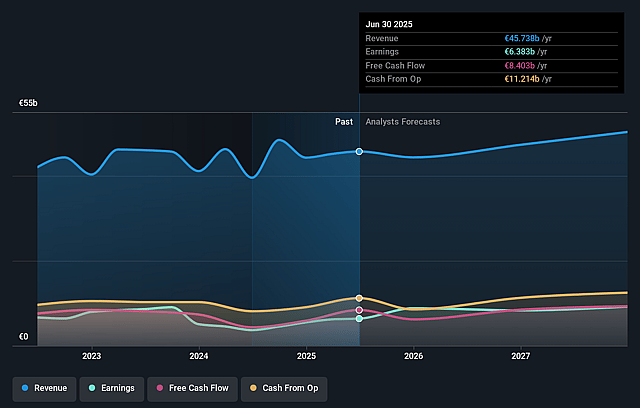
Sanofi Future Earnings and Revenue Growth
Assumptions
How have these above catalysts been quantified?
- Analysts are assuming Sanofi's revenue will grow by 3.9% annually over the next 3 years.
- Analysts assume that profit margins will increase from 10.2% today to 20.1% in 3 years time.
- Analysts expect earnings to reach €10.7 billion (and earnings per share of €8.81) by about June 2029, up from €4.8 billion today. However, there is a considerable amount of disagreement amongst the analysts with the most bullish expecting €12.4 billion in earnings, and the most bearish expecting €9.2 billion.
- In order for the above numbers to justify the price target of the analysts, the company would need to trade at a PE ratio of 12.7x on those 2029 earnings, down from 18.2x today. This future PE is lower than the current PE for the US Pharmaceuticals industry at 18.4x.
- Analysts expect the number of shares outstanding to decline by 1.06% per year for the next 3 years.
- To value all of this in today's terms, we will use a discount rate of 6.47%, as per the Simply Wall St company report.
Risks
What could happen that would invalidate this narrative?- Heightened pressure from competitive pricing, particularly in flu vaccines (expected mid-teens decline in 2025 sales from price competition in the U.S. and Germany), poses a structural risk to Sanofi's long-term vaccine franchise and could compress net margins as pricing headwinds persist beyond this year.
- Pipeline execution remains a key uncertainty: management and investors directly acknowledged that Sanofi's R&D transformation will take several years to play out, and that some high-profile late-stage assets have produced "mixed" results or outright Phase III failures (e.g., itepekimab in COPD), increasing the risk of slower revenue and earnings growth if pipeline assets don't materialize as expected.
- Sanofi's heavy investment in new launches and recent acquisitions (e.g., Blueprint, Vigil Neuroscience, Vicebio), while offering promising long-term growth avenues, has resulted in higher SG&A and R&D expenses; failure to generate expected returns from these investments or delayed integration could limit operating leverage and compress net margins in the coming years.
- The expiration of patent protection for key blockbuster drugs like Dupixent (U.S. 2031, EU 2033) and increasing biosimilar/generic competition industry-wide mean Sanofi faces the risk of accelerating revenue erosion post-exclusivity, particularly as payers, governments, and insurers globally push harder for drug price reductions and transparency.
- Intensified regulatory and geopolitical uncertainty-such as potential U.S. tariffs on EU pharmaceuticals, drug pricing reforms in both the U.S. and Europe, and lengthening approval timelines amid higher regulatory scrutiny-could drive higher operating costs, strain international sales, and directly impair net earnings.
Valuation
How have all the factors above been brought together to estimate a fair value?
- The analysts have a consensus price target of €96.7 for Sanofi based on their expectations of its future earnings growth, profit margins and other risk factors.
- However, there is a degree of disagreement amongst analysts, with the most bullish reporting a price target of €112.0, and the most bearish reporting a price target of just €82.0.
- In order for you to agree with the analysts, you'd need to believe that by 2029, revenues will be €53.2 billion, earnings will come to €10.7 billion, and it would be trading on a PE ratio of 12.7x, assuming you use a discount rate of 6.5%.
- Given the current share price of €73.34, the analyst price target of €96.7 is 24.2% higher.
- We always encourage you to reach your own conclusions though. So sense check these analyst numbers against your own assumptions and expectations based on your understanding of the business and what you believe is probable.
Have other thoughts on Sanofi?
Create your own narrative on this stock, and estimate its Fair Value using our Valuator tool.
Create NarrativeHow well do narratives help inform your perspective?
Disclaimer
AnalystConsensusTarget is a tool utilizing a Large Language Model (LLM) that ingests data on consensus price targets, forecasted revenue and earnings figures, as well as the transcripts of earnings calls to produce qualitative analysis. The narratives produced by AnalystConsensusTarget are general in nature and are based solely on analyst data and publicly-available material published by the respective companies. These scenarios are not indicative of the company's future performance and are exploratory in nature. Simply Wall St has no position in the company(s) mentioned. Simply Wall St may provide the securities issuer or related entities with website advertising services for a fee, on an arm's length basis. These relationships have no impact on the way we conduct our business, the content we host, or how our content is served to users. The price targets and estimates used are consensus data, and do not constitute a recommendation to buy or sell any stock, and they do not take account of your objectives, or your financial situation. Note that AnalystConsensusTarget's analysis may not factor in the latest price-sensitive company announcements or qualitative material.


