

Last Update 05 Aug 26
Fair value Increased 3.07%ULVR: Volume Momentum And Foods Merger Plans May Support Balanced Medium Term Outlook
Analysts have raised their core price target for Unilever to £3,800 from £3,700, pointing to recent volume led earnings beats, modestly higher medium term EPS estimates and slightly firmer margin and growth assumptions, even as some still flag risks to mid term volume and margin goals.
Analyst Commentary
Recent research on Unilever shows a split between bullish analysts who see improving execution and earnings support, and bearish analysts who remain cautious on the durability of volume growth and margins. The mixed views are feeding directly into how the stock is being valued and how much credit the market is giving to the current earnings profile.
Bullish Takeaways
- Bullish analysts highlight the Q2 volume led sales beat, with reported volume or mix gains outpacing prior expectations and supporting confidence in Unilever's ability to drive growth without relying solely on pricing.
- The reported Q2 sales beat of 5.8% versus consensus 4.3%, along with EPS of €1.61 versus consensus €1.59, is viewed as evidence that execution on both top line and profitability is tracking ahead of market assumptions.
- Some bullish analysts have raised their price targets, including to US$76, and slightly lifted EPS estimates for 2026 to 2028, which suggests they see current earnings power as more resilient than previously modeled.
- The raised sales outlook for the second half of the year is read as a sign that management has enough visibility and confidence in demand trends for Unilever's portfolio to justify higher near term growth expectations.
Bearish Takeaways
- Bearish analysts continue to question Unilever's ability to sustain volume and margin ambitions over the medium term, which they see as a key risk to the stock's core valuation even after recent beats.
- Some remain cautious about tougher comparisons ahead, noting that while an easier first half 2025 comparison supports volume or mix growth in Q2 2026, the comparison is expected to be roughly double in the second half, which could make it harder to maintain current growth rates.
- The decision by bearish analysts to keep Underperform ratings despite raising EPS estimates, including an increase of about 3% for FY26 to FY28, signals concern that the share price already reflects optimistic assumptions on execution.
- One bearish view is that parity with U.S. peers on valuation looks stretched, which implies that any stumble in delivering against volume or margin goals could lead to pressure on Unilever's share price relative to those peers.
What’s in the News for Unilever
- Unilever reported its strongest quarterly sales performance in more than ten years, with underlying sales growth supported by double digit gains in beauty brands such as Dove, Sunsilk and Vaseline. The company raised its full year sales growth outlook to within its 4% to 6% medium term guidance range and indicated an expectation for a modest improvement in operating margin. Source, recent earnings coverage.
- Unilever plans to spin off its food business into a joint venture with US company McCormick in a deal valued at £33.8b. McCormick intends to seek a secondary listing in London while keeping its primary listing in New York, which is aimed at supporting liquidity for Unilever’s international shareholders. Source, recent deal announcement.
- As part of the McCormick merger, Unilever has committed to protect employment terms for about 4,800 workers across its European and UK food businesses for two years after completion, following discussions with its European Works Council. This addresses concerns around potential job cuts for roughly one third of its regional food workforce. Source, recent merger related reporting.
- Unilever secured a FIFA World Cup 2026 sponsorship, which covers over 35 brands across 120 markets. The Dove Men+Care campaign built around this sponsorship is already in market and focuses on skin care for soccer fans, including ticket promotions, creator partnerships and on the ground fan events in US host cities. Source, company announcements on the sponsorship and campaign.
Valuation Changes for Unilever
- Fair Value has risen slightly, with the core estimate moving from £51.15 to £52.72.
- Discount Rate has edged lower from 8.11% to 7.98%, indicating a modestly lower required return in the updated model.
- € Revenue Growth has been set higher, moving from 3.07% to 4.06% in the updated assumptions.
- € Net Profit Margin has been raised slightly from 13.14% to 13.47%, pointing to a small uplift in expected profitability.
- Future P/E has been reduced from 22.48x to 20.92x, which means the valuation framework now applies a lower earnings multiple to Unilever.
Key Takeaways
- Shifting focus to premium, science-led products and divesting non-core brands is streamlining operations, boosting margins, and enhancing long-term profitability.
- Emphasis on digital expansion, emerging markets, and brand investment is fueling sustained revenue growth and stronger competitive positioning.
- Intensifying competition, regional underperformance, input cost pressures, portfolio streamlining, and elevated regulatory scrutiny threaten sustainable revenue growth, margin expansion, and brand stability.
Catalysts
About Unilever- Operates as a fast-moving consumer goods company in the Asia Pacific, Africa, the Americas, and Europe.
- Acceleration of volume growth in key emerging markets (India, China, Indonesia), supported by rising disposable incomes, urbanization, and rapid expansion in digital/e-commerce channels, is expected to drive sustained top-line revenue growth as these markets recover and Unilever gains market share.
- Portfolio transformation with a sharper focus on premium and science-led Personal Care and Beauty & Wellbeing products, coupled with bolt-on acquisitions of fast-growing digitally native brands, is increasing exposure to higher-margin categories and supporting long-term margin and earnings expansion.
- Strategic divestitures, including the demerger of Ice Cream and continued disposal of non-core food brands, are simplifying the business model and structurally raising the gross and operating margin profile of the remaining company, directly improving profitability and ROIC.
- Improved productivity via supply chain digitization, procurement efficiencies, and disciplined cost management (targeted cost savings of €650 million in 2025) are enhancing gross margins, providing additional fuel for competitive brand investment, and supporting higher sustainable earnings growth.
- Increased investment in brand marketing (15–16% of revenue, notably in Power Brands and digital commerce) is driving innovation, strengthening brand equity, and enabling Unilever to better capture evolving consumer demand in wellness, health, and premiumization, likely resulting in higher revenue growth and maintained or expanded market share.
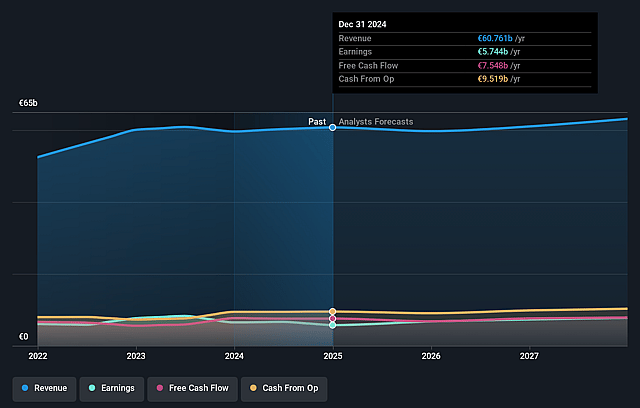
Unilever Future Earnings and Revenue Growth
Assumptions
How have these above catalysts been quantified?
- Analysts are assuming Unilever's revenue will grow by 4.1% annually over the next 3 years.
- Analysts assume that profit margins will increase from 11.1% today to 13.5% in 3 years time.
- Analysts expect earnings to reach €7.7 billion (and earnings per share of €3.43) by about August 2029, up from €5.6 billion today. The analysts are largely in agreement about this estimate.
- In order for the above numbers to justify the price target of the analysts, the company would need to trade at a PE ratio of 20.9x on those 2029 earnings, down from 21.3x today. This future PE is greater than the current PE for the US Personal Products industry at 16.6x.
- Analysts expect the number of shares outstanding to decline by 1.2% per year for the next 3 years.
- To value all of this in today's terms, we will use a discount rate of 7.98%, as per the Simply Wall St company report.
Risks
What could happen that would invalidate this narrative?- Intensifying competition from private label and local/niche brands-especially in personal care and food-in key markets like the US and Europe threatens Unilever's long-term pricing power and could erode market share, undermining revenue growth and margin expansion.
- Weak emerging market performance, particularly chronic volume declines in Latin America and flat or negative trends in China and Indonesia, exposes the company to ongoing regional underperformance, creating persistent drag on group revenue and structural headwinds for growth.
- Ongoing input cost inflation (commodities, packaging, transport) and adverse currency movements, especially pronounced in 2025, have pressured operating margins and led to reliance on price increases that may not be sustainable, risking future profitability and earnings.
- The company's continuing portfolio rationalization-including divestitures like the Ice Cream unit and underperforming food brands-could reduce overall scale benefits and increase business concentration, potentially leading to revenue volatility, reduced diversification, and uneven margin trajectory if not offset by sufficient growth in premium categories.
- Heightened regulatory, environmental, and consumer scrutiny around sustainability, ingredient transparency, and global tax regimes-increasing compliance costs and reputational risks-may constrain long-term margin improvement and require ongoing heavy investment to maintain brand equity and customer trust.
Valuation
How have all the factors above been brought together to estimate a fair value?
- The analysts have a consensus price target of £52.72 for Unilever based on their expectations of its future earnings growth, profit margins and other risk factors.
- However, there is a degree of disagreement amongst analysts, with the most bullish reporting a price target of £60.04, and the most bearish reporting a price target of just £38.11.
- In order for you to agree with the analysts, you'd need to believe that by 2029, revenues will be €57.0 billion, earnings will come to €7.7 billion, and it would be trading on a PE ratio of 20.9x, assuming you use a discount rate of 8.0%.
- Given the current share price of £47.48, the analyst price target of £52.72 is 9.9% higher.
- We always encourage you to reach your own conclusions though. So sense check these analyst numbers against your own assumptions and expectations based on your understanding of the business and what you believe is probable.
Have other thoughts on Unilever?
Create your own narrative on this stock, and estimate its Fair Value using our Valuator tool.
Create NarrativeHow well do narratives help inform your perspective?
Comments
0 commentsDisclaimer
AnalystConsensusTarget is a tool utilizing a Large Language Model (LLM) that ingests data on consensus price targets, forecasted revenue and earnings figures, as well as the transcripts of earnings calls to produce qualitative analysis. The narratives produced by AnalystConsensusTarget are general in nature and are based solely on analyst data and publicly-available material published by the respective companies. These scenarios are not indicative of the company's future performance and are exploratory in nature. Simply Wall St has no position in the company(s) mentioned. Simply Wall St may provide the securities issuer or related entities with website advertising services for a fee, on an arm's length basis. These relationships have no impact on the way we conduct our business, the content we host, or how our content is served to users. The price targets and estimates used are consensus data, and do not constitute a recommendation to buy or sell any stock, and they do not take account of your objectives, or your financial situation. Note that AnalystConsensusTarget's analysis may not factor in the latest price-sensitive company announcements or qualitative material.


