
Last Update 22 Jun 26
Fair value Decreased 0.56%DUK: Data Center Pipeline And Nuclear Lifecycle Will Drive Future Power Demand
Duke Energy's analyst price targets have been trimmed by a few dollars to around the mid $130s, as analysts factor in regulatory uncertainty around coal retirements and data center pushback, while still referencing execution, scale, and a sizable data center pipeline in their updated views.
Analyst Commentary
Recent research on Duke Energy reflects a mixed but generally constructive tone, with analysts adjusting price targets into a tighter band while weighing regulatory risk against execution on large growth projects like data centers and potential nuclear development.
Bullish Takeaways
- Bullish analysts highlight Duke Energy's execution, pointing to improved financial performance under the relatively new management team and citing this as a support for valuation even as price targets shift.
- The company’s scale and geographic diversity are seen as positives, with several analysts arguing that this breadth provides a more resilient foundation for growth and capital deployment.
- Duke Energy’s 15 gigawatt data center pipeline is described as vetted and executable, with expectations for 6 to 7 GWs of contracts to be signed this year, which bullish analysts see as a key driver for long term load growth and earnings potential.
- Some research points to vertically integrated electric utilities as clear beneficiaries of the ongoing data center buildout, with Duke Energy often grouped among companies that could benefit from rising infrastructure investment tied to this trend.
Bearish Takeaways
- Bearish analysts and those trimming price targets flag regulatory uncertainty, particularly around North Carolina SB 730, which could delay coal retirements until a 1,000 megawatt nuclear certificate of public convenience and necessity is issued, adding risk to planning and capital allocation.
- Local and potential state level pushback on data centers is cited as a material risk if it broadens, with Duke Energy listed among the utilities most exposed to community and policy resistance that could slow or reshape future growth projects.
- Some research notes that utilities, including Duke Energy, underperformed the S&P’s return in a recent month, which feeds into more cautious stances on valuation even when fundamentals are viewed as stable.
- Neutral views, such as the Equal Weight and Neutral ratings, indicate that for some analysts the current share price already reflects near term opportunities and risks, limiting perceived upside until there is more clarity on regulation and data center execution.
What’s in the News for Duke Energy
- Duke Energy reported first quarter 2026 earnings of US$1.93 per share, above analyst estimates, and outlined adjusted EPS guidance of US$6.55 to US$6.80 for 2026. This guidance is supported by a US$103b capital plan focused on grid upgrades, nuclear fleet maintenance, renewables, and more than 13 gigawatts of new generation capacity by 2030. [Source: recent earnings coverage]
- AI driven data center demand remains a central theme for Duke Energy, with 7.6 gigawatts already under contract and a further 15 gigawatts in late stage development. This frames much of the discussion around long term load growth and capital deployment. [Source: recent earnings coverage]
- Duke Energy received a U.S. Department of Energy grant of up to US$61.8m for refurbishment and reliability upgrades at coal plants in Kentucky and North Carolina, bringing total recent DOE support for these coal facility projects to nearly US$96m. The grants are aimed at maintaining operational reliability and managing customer costs. [Source: DOE grant reports]
- The company has applied for loans from the U.S. Department of Energy to help finance capacity additions and grid reinforcement across the Southeast and Midwest. The goal is to lower interest costs on key projects and, in turn, ease customer energy bills. [Source: DOE loan application coverage]
- Duke Energy’s Robinson Nuclear Plant in South Carolina received a 20 year license renewal from the U.S. Nuclear Regulatory Commission, allowing operation until 2050 and supporting a generation asset that supplies about 759 megawatts of electricity, enough to serve roughly 570,000 homes. [Source: NRC license renewal notice]
Valuation Changes for Duke Energy
- Fair Value: Trimmed slightly from $138.61 to $137.83. This reflects a modest recalibration rather than a major shift in outlook for Duke Energy.
- Discount Rate: Held effectively unchanged at 7.11%. This indicates no material adjustment to the assumed risk profile in the updated work.
- Revenue Growth: Ticked down marginally from 4.81% to 4.80%. This signals a very small change in expected top line expansion assumptions.
- Net Profit Margin: Edged higher from 16.87% to 16.90%. This implies a slightly firmer view on future profitability levels.
- Future P/E: Eased from 21.04x to 20.88x. This suggests a modestly lower valuation multiple applied to Duke Energy’s forward earnings.
Key Takeaways
- Strong regional economic activity and supportive legislation are expected to drive sustained growth in revenues, earnings stability, and operational efficiency.
- Investment in grid modernization, renewables, and nuclear enhances financial flexibility and positions Duke favorably for the ongoing energy transition.
- Accelerating distributed energy adoption, regulatory risks, capital needs, and fossil fuel reliance threaten Duke Energy's revenue growth, margins, and financial flexibility amid the energy transition.
Catalysts
About Duke Energy- Through its subsidiaries, operates as an energy company in the United States.
- Major economic development wins (e.g., AWS's $10B data center in North Carolina), paired with accelerated migration and manufacturing demand in Duke's service territory, are expected to drive robust, multi-year load and volume growth, supporting higher revenues and long-term EPS growth.
- Supportive state and federal legislation-such as the Power Bill Reduction Act in NC and the Energy Security Act in SC-streamlines cost recovery for new generation and grid investments, reducing regulatory lag and improving cash flow and earnings stability over the next decade.
- Significant infrastructure and grid modernization investment (e.g., over $4 billion incremental CapEx in Florida) is positioned to capitalize on growing needs for digitalization and grid resilience, enabling Duke to enhance operational efficiency and reliability, which benefits both net margins and future rate base growth.
- Proceeds from recent asset sales and the minority stake sale (e.g., Brookfield in Florida) are being used to strengthen the balance sheet and de-risk future equity needs, improving the company's financial flexibility and lowering funding costs, which in turn should protect or expand net margins and earnings.
- Duke's large-scale commitment to nuclear and renewables (operating the nation's largest regulated nuclear fleet, plus long-term renewables investment pipeline) aligns with the ongoing clean energy transition, securing regulatory support and capturing production tax credits-directly boosting earnings and reducing exposure to commodity price volatility.
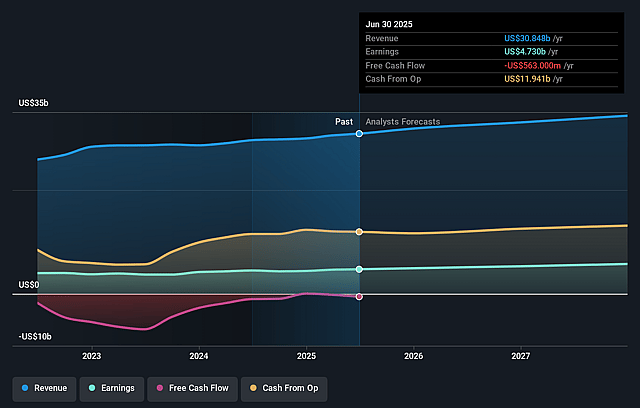
Duke Energy Future Earnings and Revenue Growth
Assumptions
How have these above catalysts been quantified?
- Analysts are assuming Duke Energy's revenue will grow by 4.8% annually over the next 3 years.
- Analysts assume that profit margins will increase from 15.5% today to 16.9% in 3 years time.
- Analysts expect earnings to reach $6.4 billion (and earnings per share of $7.79) by about June 2029, up from $5.1 billion today. The analysts are largely in agreement about this estimate.
- In order for the above numbers to justify the price target of the analysts, the company would need to trade at a PE ratio of 20.9x on those 2029 earnings, up from 19.1x today. This future PE is lower than the current PE for the US Electric Utilities industry at 21.4x.
- Analysts expect the number of shares outstanding to grow by 0.25% per year for the next 3 years.
- To value all of this in today's terms, we will use a discount rate of 7.11%, as per the Simply Wall St company report.
Risks
What could happen that would invalidate this narrative?- Accelerating distributed energy adoption, such as solar and batteries by customers and businesses, could reduce long-term demand for Duke Energy's centralized grid services and utility-provided electricity, leading to potential stagnation or decline in sales and ultimately pressuring long-term revenue growth.
- Heavy reliance on natural gas and legacy coal infrastructure complicates Duke's transition to renewables, which could result in higher capital expenditures, increased compliance costs, and exposure to stranded asset risk as decarbonization policies accelerate-negatively impacting net margins and future earnings.
- Significant increases in capital needs for grid modernization, generation investments, and new project developments-especially to serve large customers like data centers-raise Duke Energy's dependence on external financing, amplifying vulnerability to persistent inflation and higher interest rates that can compress returns and elevate interest expense, thereby reducing net income.
- While recent legislative and regulatory outcomes have been supportive, any future unfavourable regulatory changes (such as potential shifts to performance-based ratemaking or customer rate resistance) could introduce earnings variability, limit guaranteed returns, or constrain rate base growth, all of which may adversely affect regulated revenue and EPS trajectory.
- Elevated balance sheet leverage and large deferred equity issuance plans heighten refinancing and credit downgrade risks, particularly if capital markets tighten or operational execution falters, which could increase borrowing costs, reduce financial flexibility, and ultimately negatively impact net income and shareholder returns.
Valuation
How have all the factors above been brought together to estimate a fair value?
- The analysts have a consensus price target of $137.83 for Duke Energy based on their expectations of its future earnings growth, profit margins and other risk factors.
- In order for you to agree with the analysts, you'd need to believe that by 2029, revenues will be $37.7 billion, earnings will come to $6.4 billion, and it would be trading on a PE ratio of 20.9x, assuming you use a discount rate of 7.1%.
- Given the current share price of $123.86, the analyst price target of $137.83 is 10.1% higher.
- We always encourage you to reach your own conclusions though. So sense check these analyst numbers against your own assumptions and expectations based on your understanding of the business and what you believe is probable.
Have other thoughts on Duke Energy?
Create your own narrative on this stock, and estimate its Fair Value using our Valuator tool.
Create NarrativeHow well do narratives help inform your perspective?
Comments
0 commentsDisclaimer
AnalystConsensusTarget is a tool utilizing a Large Language Model (LLM) that ingests data on consensus price targets, forecasted revenue and earnings figures, as well as the transcripts of earnings calls to produce qualitative analysis. The narratives produced by AnalystConsensusTarget are general in nature and are based solely on analyst data and publicly-available material published by the respective companies. These scenarios are not indicative of the company's future performance and are exploratory in nature. Simply Wall St has no position in the company(s) mentioned. Simply Wall St may provide the securities issuer or related entities with website advertising services for a fee, on an arm's length basis. These relationships have no impact on the way we conduct our business, the content we host, or how our content is served to users. The price targets and estimates used are consensus data, and do not constitute a recommendation to buy or sell any stock, and they do not take account of your objectives, or your financial situation. Note that AnalystConsensusTarget's analysis may not factor in the latest price-sensitive company announcements or qualitative material.
Read more narratives

Duke Energy Deepens ESG Commitment with $375K in Earth Month Grants Across South Carolina
View narrative