

Last Update 05 Aug 26
Fair value Increased 3.93%PAYX: AI And Paycor Synergies Will Test Dividend Support And Execution
Paychex's fair value estimate has been raised by about $4 to $109.57 as analysts factor in a slightly lower discount rate, a modest adjustment to expected revenue growth, and a higher projected profit margin supported by recent price target increases across the Street.
Analyst Commentary
Recent Street research on Paychex shows a mix of optimism and caution around the stock's valuation, growth outlook, and execution following fiscal Q4 results and the Paycor acquisition.
Bullish Takeaways
- Bullish analysts have lifted price targets into a range that extends up to US$150, which signals confidence that current valuation can be supported if Paychex meets their expectations on growth and margins.
- Some bullish analysts point to the Paycor acquisition as a key part of the story, with expected synergies viewed as a support for revenue growth and profitability over time.
- Commentary following fiscal Q4 results indicates more confidence in the setup for FY27, which supports the idea that earnings visibility may be improving compared with FY26.
- Analysts highlighting the company's dividend and describing it as a source of stability see Paychex as appealing for investors who want income and some exposure to growth in employer services.
Bearish Takeaways
- Bearish analysts keeping Underweight or Neutral views, including JPMorgan, acknowledge solid recent results but still see limited upside relative to their price targets, which tempers enthusiasm around the current valuation.
- One research update reduced its price target to US$98 and flagged revenue growth as a key focus for 2027, which reflects concern around the pace of top line execution beyond the next year.
- Several firms maintain Hold or equivalent ratings even as they raise targets, which indicates that, in their view, the stock already reflects a fair amount of the expected growth and synergy benefits.
- Expectations around upcoming guidance, including views that FY27 may end up relatively in line with current consensus, suggest some analysts see limited room for positive surprises on growth or margins in the near term.
What’s in the News for Paychex
- Paychex launched Workforce Intelligence Strengthened by Expertise, or WISE, an AI-powered intelligence solution that sits across Paychex Flex, Paycor, and SurePayroll and is designed to support HR tasks, predictive analytics, and advisory workflows. Source: Company product announcement.
- The company announced that WISE is now available within Microsoft 365 Copilot and Teams, which extends Paychex workforce intelligence tools into collaboration platforms that many customers already use. Source: Company client announcement.
- Paychex provided earnings guidance for the fiscal year ending May 31, 2027, with total revenue anticipated to grow in the range of 5% to 6%. Source: Company guidance update.
- From March 1, 2026 to May 31, 2026, Paychex repurchased 2,700,000 shares for US$247 million and completed a total of 3,500,000 shares repurchased for US$322 million under the buyback announced on January 16, 2026. Source: Buyback tranche update.
- Paychex stock was removed from several Russell growth and growth defensive benchmarks, including the Russell 1000 Growth, Russell 3000 Growth, Russell 3000E Growth, and Russell Midcap Growth benchmarks. Source: Index constituent change notices.
Valuation Changes for Paychex
- Fair Value has risen slightly from $105.43 to $109.57, reflecting a modest uplift in the valuation model for Paychex.
- The Discount Rate has fallen slightly from 7.62% to 7.48%, supporting a higher present value for future cash flows.
- Revenue Growth has been trimmed from 6.66% to 5.33%, pointing to a more measured outlook for dollar revenue expansion in the model.
- Net Profit Margin has edged higher from 30.50% to 31.34%, indicating a slightly stronger profitability profile for Paychex in the updated assumptions.
- Future P/E has moved slightly lower from 19.73x to 19.57x, implying a very small adjustment to the valuation multiple used for Paychex.
Key Takeaways
- The acquisition of Paycor is expected to enhance Paychex's market position through an expanded customer base and improved revenue opportunities.
- Investments in technology and AI focus could boost efficiency, client retention, and revenue growth, strengthening the company’s overall performance.
- Integration challenges with Paycor and rising employee costs threaten margins, while reliance on relief programs underscores revenue vulnerabilities amidst uncertain economic conditions.
Catalysts
About Paychex- Provides integrated human capital management solutions (HCM) for payroll, benefits, human resources (HR), and insurance services for small to medium-sized businesses in the United States, Europe, and India.
- The pending acquisition of Paycor is expected to strengthen Paychex's competitive position by expanding its customer base and offering a more comprehensive HCM portfolio, which could drive revenue growth through cross-selling opportunities.
- Investments in automation and technology are boosting efficiency, resulting in an increased operating margin, with further potential margin improvements anticipated from cost synergies over $80 million from the Paycor acquisition.
- Paychex's focus on AI-driven solutions, like the new Gen AI-powered HR Copilot tool, is likely to enhance client engagement and operational efficiency, which could positively impact earnings and net margins.
- The improved client retention rates and decreased client losses signal a strong value proposition, supporting stable revenue streams and potential revenue growth as the company retains more high-value clients.
- The strategic focus on expanding sales coverage and investment in product development post-Paycor acquisition is expected to drive future revenue growth and enhance overall company performance.
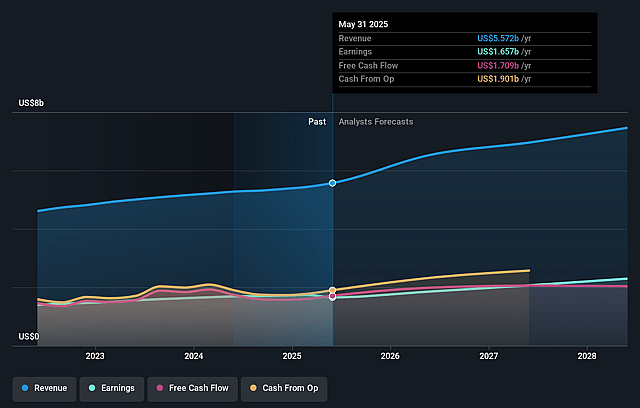
Paychex Future Earnings and Revenue Growth
Assumptions
How have these above catalysts been quantified?
- Analysts are assuming Paychex's revenue will grow by 5.3% annually over the next 3 years.
- Analysts assume that profit margins will increase from 27.0% today to 31.3% in 3 years time.
- Analysts expect earnings to reach $2.4 billion (and earnings per share of $6.73) by about August 2029, up from $1.8 billion today. The analysts are largely in agreement about this estimate.
- In order for the above numbers to justify the price target of the analysts, the company would need to trade at a PE ratio of 19.6x on those 2029 earnings, down from 24.0x today. This future PE is lower than the current PE for the US Professional Services industry at 22.6x.
- Analysts expect the number of shares outstanding to decline by 1.17% per year for the next 3 years.
- To value all of this in today's terms, we will use a discount rate of 7.48%, as per the Simply Wall St company report.
Risks
What could happen that would invalidate this narrative?- The acquisition of Paycor, while expected to bring synergies, involves risks such as integration challenges and potential execution missteps, which could impact net margins and earnings.
- The expiration of the Employee Retention Tax Credit (ERTC) program is no longer a headwind, but past reliance on such programs highlights potential vulnerabilities in revenue growth without similar government relief programs.
- Market conditions including elevated employee costs and clients opting for lower-cost health plans, particularly in Florida, create revenue headwinds and may not pass through to earnings, affecting net margins.
- Changes in client behavior, such as increased shopping for health coverage due to inflation and smaller deal sizes, could affect future revenue and client retention rates.
- The ongoing macroeconomic uncertainty, including moderate U.S. job growth and small business confidence, could impact checks per client, leading to potential stagnation in revenue streams.
Valuation
How have all the factors above been brought together to estimate a fair value?
- The analysts have a consensus price target of $109.57 for Paychex based on their expectations of its future earnings growth, profit margins and other risk factors.
- However, there is a degree of disagreement amongst analysts, with the most bullish reporting a price target of $150.0, and the most bearish reporting a price target of just $95.0.
- In order for you to agree with the analysts, you'd need to believe that by 2029, revenues will be $7.6 billion, earnings will come to $2.4 billion, and it would be trading on a PE ratio of 19.6x, assuming you use a discount rate of 7.5%.
- Given the current share price of $118.66, the analyst price target of $109.57 is 8.3% lower. The relatively low difference between the current share price and the analyst consensus price target indicates that they believe on average, the company is fairly priced.
- We always encourage you to reach your own conclusions though. So sense check these analyst numbers against your own assumptions and expectations based on your understanding of the business and what you believe is probable.
Have other thoughts on Paychex?
Create your own narrative on this stock, and estimate its Fair Value using our Valuator tool.
Create NarrativeHow well do narratives help inform your perspective?
Comments
0 commentsDisclaimer
AnalystConsensusTarget is a tool utilizing a Large Language Model (LLM) that ingests data on consensus price targets, forecasted revenue and earnings figures, as well as the transcripts of earnings calls to produce qualitative analysis. The narratives produced by AnalystConsensusTarget are general in nature and are based solely on analyst data and publicly-available material published by the respective companies. These scenarios are not indicative of the company's future performance and are exploratory in nature. Simply Wall St has no position in the company(s) mentioned. Simply Wall St may provide the securities issuer or related entities with website advertising services for a fee, on an arm's length basis. These relationships have no impact on the way we conduct our business, the content we host, or how our content is served to users. The price targets and estimates used are consensus data, and do not constitute a recommendation to buy or sell any stock, and they do not take account of your objectives, or your financial situation. Note that AnalystConsensusTarget's analysis may not factor in the latest price-sensitive company announcements or qualitative material.


