

Last Update 03 Jul 26
Fair value Increased 2.38%GIS: Cost Savings And Portfolio Reset Will Drive Cautious Earnings Path Forward
Analysts have nudged the General Mills price framework higher, with the modeled fair value rising by about $0.88 to $37.88 as they balance softer long term revenue growth assumptions against slightly stronger margin expectations and a modestly lower future P/E multiple in line with recent price target revisions across the Street.
Analyst Commentary
Recent Street research on General Mills highlights a mixed backdrop, with several firms lifting price targets after earnings while others trim expectations on concerns about costs, categories, and consumer pressure. For you as an investor, the key debate centers on how reliable the company’s earnings power is through fiscal 2027 and what multiple that stream should command.
Bullish Takeaways
- Bullish analysts who raised price targets into the low to mid US$30s point to recent earnings beats, where Q4 results were supported by stronger sales and margins, as evidence that General Mills can still defend profitability even as revenue growth expectations are reset lower.
- Multiple firms highlight improved inflation trends and a better than feared cost outlook. This supports slightly higher margin assumptions and helps justify modest P/E frameworks even as top line assumptions remain cautious.
- Some research sees room for upside to longer term earnings if planned savings programs and brand investment translate into more resilient categories over time. If executed well, this could support the mid US$30s to high US$30s fair value range used in updated models.
- One bullish view is that the sharp stock reaction around the Q4 earnings beat was driven by short covering and excessive pessimism rather than a sudden change in fundamentals. This may leave room for valuation to settle closer to mid cycle levels if execution holds.
Bearish Takeaways
- Bearish analysts, including several with Underweight or Sell ratings, have cut targets into the low US$30s or high US$20s, citing incremental cost inflation, commodity volatility, and limited pricing power as key headwinds for General Mills as it moves toward fiscal 2027.
- Multiple research notes flag pressured categories, a stressed consumer, and exposure to higher freight, agriculture, and packaging costs as risks to both revenue stability and margin durability. These factors can justify lower P/E multiples in updated models.
- Some analysts see the FY27 outlook as challenged, with commentary around another year of earnings or margin compression and a slower Q1. This raises execution risk around a second half weighted year and limits enthusiasm for multiple expansion.
- Broader sector downgrades point to structural pressures for traditional packaged food companies, including health and wellness trends, reduced Supplemental Nutrition Assistance Program benefits, and legal or policy risk. Bearish analysts argue that these issues may cap valuation for General Mills even if near term earnings are supported.
What’s in the News for General Mills
- General Mills reported fiscal 2026 net sales of US$18.4b, down 5%, with operating profit falling 73% to US$885.8m and a diluted loss per share of US$0.16, driven mainly by US$1.75b of non cash impairments in the North America Pet business; adjusted operating profit and adjusted diluted EPS each declined 16%, to US$2.81b and US$3.55 respectively, and the company guided to fiscal 2027 organic net sales between a 1.5% decline and 0.5% growth with adjusted operating profit expected to fall 8 to 13% (source: fiscal 2026 results summary).
- For fiscal Q4 2026, General Mills reported adjusted EPS of US$0.95, US$0.15 above analyst estimates, on revenue of US$4.61b that rose 1.2% year over year despite a 4% drop in sales volumes, while operating profit was affected by non cash impairment charges tied to goodwill, brand intangibles, and a planned Brazil divestiture (source: Q4 2026 earnings summary).
- Management outlined a cost savings program targeting US$3b in cumulative savings through fiscal 2030, including US$750m in fiscal 2027, and reiterated plans to support organic growth with product renovation, brand spending, and a focus on innovation and remarkability across key categories (source: Q4 2026 earnings summary and fiscal 2027 outlook).
- Several research firms lowered price targets on General Mills and shifted ratings mostly to Neutral or Underweight after fiscal 2026 results, citing volume declines in North America Retail and Pet, profit pressure, weaker growth forecasts through fiscal 2027, a stock price that has fallen over 30% since late 2025, and rising concern about the sustainability of a dividend yield above 7% alongside falling EPS and negative free cash flow trends (source: analyst commentary roundup).
- General Mills continued returning capital to shareholders, repurchasing 13,504,687 shares for US$500m between February 23 and May 31, 2026, completing a program that has retired 86,607,518 shares for a total of US$5,430.31m since it was announced on June 30, 2022 (source: buyback tranche update).
Valuation Changes for General Mills
- Fair Value: The modeled fair value for General Mills has risen slightly from $37.00 to about $37.88 per share, reflecting modest tweaks to the forecast framework.
- Discount Rate: The discount rate is effectively unchanged at about 7.11%, indicating a consistent required return assumption in the model.
- Revenue Growth: The long term revenue growth assumption has been revised lower, from a decline of about 4.44% to a steeper decline of about 24.11%.
- Net Profit Margin: The projected profit margin has edged higher from roughly 9.66% to about 10.00%, implying slightly firmer earnings expectations on each dollar of sales.
- Future P/E: The future P/E multiple applied to General Mills has eased slightly from about 13.03x to roughly 12.93x, signaling a modest reduction in the valuation multiple used in the model.
Key Takeaways
- General Mills’ increased investment and reinvestment strategy may delay improvements in net margins and earnings in the short term.
- Challenges like the potential Yoplait closure and changing consumer behavior could suppress revenue growth and impact future earnings projections.
- General Mills' focus on strategic reinvestment, targeted marketing, and innovation aims to enhance competitiveness and drive future revenue and earnings growth.
Catalysts
About General Mills- Manufactures and markets branded consumer foods worldwide.
- General Mills plans a sizable step-up in investment for fiscal '26, including at least 5% through Holistic Margin Management (HMM) savings and $100 million in additional cost savings. However, reinvestment of these savings into pricing, innovation, in-store activity, and media could delay improvements in net margins and overall earnings in the short term.
- The company faces a challenging consumer environment, with low consumer confidence leading to increased value-seeking behavior. Even as General Mills invests in competitive pricing and marketing to address this, the shift in consumer behavior may suppress revenue growth in the near term.
- General Mills expects a significant headwind from the potential closure of the Yoplait business, equivalent to a 5-point hit on profit. This anticipated drop in profit could affect future earnings projections and contribute to a perception of overvaluation.
- Continued investment will be necessary to make pricing adjustments for snacks and to improve competitiveness across various brands. Such investments may not immediately boost earnings, as achieving the right pricing balance will take time, potentially affecting revenue and net margins.
- General Mills' strategy of fewer, but bigger innovations in fiscal '26 involves focusing on a smaller number of larger innovations. While this may benefit future revenue growth, the time required to develop and execute such innovations means immediate impacts on earnings might be limited.
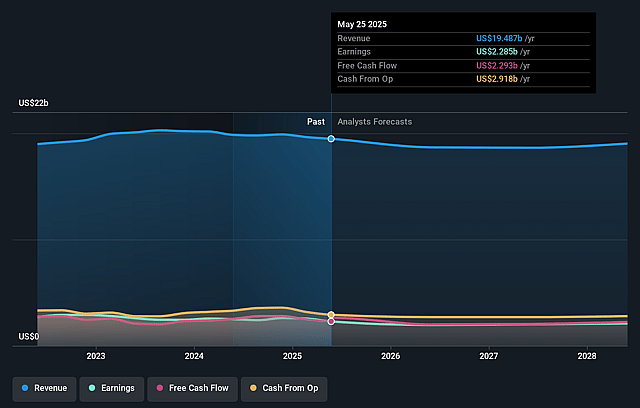
General Mills Future Earnings and Revenue Growth
Assumptions
How have these above catalysts been quantified?
- Analysts are assuming General Mills's revenue will remain fairly flat over the next 3 years.
- Analysts assume that profit margins will increase from -0.5% today to 10.0% in 3 years time.
- Analysts expect earnings to reach $1.8 billion (and earnings per share of $3.49) by about July 2029, up from -$87.6 million today. The analysts are largely in agreement about this estimate.
- In order for the above numbers to justify the price target of the analysts, the company would need to trade at a PE ratio of 12.9x on those 2029 earnings, up from -228.9x today. This future PE is lower than the current PE for the US Food industry at 16.0x.
- Analysts expect the number of shares outstanding to decline by 1.61% per year for the next 3 years.
- To value all of this in today's terms, we will use a discount rate of 7.11%, as per the Simply Wall St company report.
Risks
What could happen that would invalidate this narrative?- General Mills plans to reinvest savings from cost efficiencies and the 53rd week of fiscal year into marketing and innovation, potentially improving competitiveness and driving revenue growth.
- The company has identified several billion-dollar brands, like Blue Buffalo and Pillsbury, where refined pricing strategies and enhanced marketing have significantly improved performance, which could contribute positively to their overall earnings.
- Innovation and new product launches are being prioritized, with an emphasis on fewer, but bigger high-impact innovations, which might boost sales and revenue.
- The snack bars and cereal categories are expected to recover, with increased media expenditure and promotional activities in the upcoming quarters, which could enhance volume growth and profit margins.
- Despite current challenges, General Mills believes enhanced marketing on their core products and new innovations will significantly improve their market share and volume competitiveness, potentially leading to stronger revenue and earnings in the future.
Valuation
How have all the factors above been brought together to estimate a fair value?
- The analysts have a consensus price target of $37.88 for General Mills based on their expectations of its future earnings growth, profit margins and other risk factors.
- However, there is a degree of disagreement amongst analysts, with the most bullish reporting a price target of $57.0, and the most bearish reporting a price target of just $30.0.
- In order for you to agree with the analysts, you'd need to believe that by 2029, revenues will be $18.3 billion, earnings will come to $1.8 billion, and it would be trading on a PE ratio of 12.9x, assuming you use a discount rate of 7.1%.
- Given the current share price of $37.57, the analyst price target of $37.88 is 0.8% higher. The relatively low difference between the current share price and the analyst consensus price target indicates that they believe on average, the company is fairly priced.
- We always encourage you to reach your own conclusions though. So sense check these analyst numbers against your own assumptions and expectations based on your understanding of the business and what you believe is probable.
Have other thoughts on General Mills?
Create your own narrative on this stock, and estimate its Fair Value using our Valuator tool.
Create NarrativeHow well do narratives help inform your perspective?
Comments
0 commentsDisclaimer
AnalystConsensusTarget is a tool utilizing a Large Language Model (LLM) that ingests data on consensus price targets, forecasted revenue and earnings figures, as well as the transcripts of earnings calls to produce qualitative analysis. The narratives produced by AnalystConsensusTarget are general in nature and are based solely on analyst data and publicly-available material published by the respective companies. These scenarios are not indicative of the company's future performance and are exploratory in nature. Simply Wall St has no position in the company(s) mentioned. Simply Wall St may provide the securities issuer or related entities with website advertising services for a fee, on an arm's length basis. These relationships have no impact on the way we conduct our business, the content we host, or how our content is served to users. The price targets and estimates used are consensus data, and do not constitute a recommendation to buy or sell any stock, and they do not take account of your objectives, or your financial situation. Note that AnalystConsensusTarget's analysis may not factor in the latest price-sensitive company announcements or qualitative material.


