

Last Update 17 May 26
BKH: Higher Margin Outlook And P/E Assumptions Are Expected To Support Returns
Analysts have raised their average price target for Black Hills to $83, citing updated assumptions around revenue growth, profit margins, and a slightly adjusted P/E outlook. This revision is supported by a series of recent target hikes and rating upgrades from major firms.
Analyst Commentary
Recent research activity around Black Hills has leaned positive, with several firms lifting price targets or initiating coverage with an upbeat stance. These moves generally reflect updated views on the stock's valuation, earnings power, and execution risks.
Bullish Takeaways
- Bullish analysts raising price targets by US$4 to US$7 point to scope for the stock to move closer to their revised valuation frameworks, which factor in updated assumptions for revenue, margins, and P/E.
- The initiation with a bullish view signals confidence that Black Hills can execute on its current plan in a way that supports its earnings profile and justifies an entry point near or below the new targets.
- The upgrade to Buy with a US$82 target reinforces the idea that, at recent levels, some analysts see a gap between the market price and what they view as fair value based on their models.
- Multiple positive rating and target changes in a short window suggest growing comfort with the company’s fundamental setup and its ability to deliver on the assumptions embedded in these targets.
Bearish Takeaways
- Even with raised targets, analysts are still anchoring their views to specific P/E assumptions, which leaves the stock exposed if earnings or margin expectations are not met.
- The incremental nature of the target hikes, such as US$4 and US$7 increases, signals that analysts are refining rather than radically rethinking their valuation views, which may limit upside if expectations are already reflected in the price.
- The emphasis on updated revenue growth and profit margin assumptions means that any execution slip or shift in cost pressures could lead to revisions in those targets.
- Investors relying on these bullish calls still face the usual risks that company specific factors or sector wide sentiment could move out of sync with the forecasts underpinning the US$82 to US$83 target range.
What's in the News
- Shareholders approved amendments to Black Hills Corporation's restated articles of incorporation at a special meeting held on April 2, 2026, affecting the company's governing documents (Key Developments).
Valuation Changes
- Fair Value: $83.0, unchanged from the prior $83 level.
- Discount Rate: risen slightly from 6.978% to 7.108%, implying a modestly higher required return in the model.
- Revenue Growth: risen slightly from 15.93% to 16.80% in the updated assumptions, using dollar figures in the forecast.
- Net Profit Margin: risen slightly from 15.66% to 15.88% in the latest update, based on dollar earnings.
- Future P/E: edged lower from 15.33x to 15.17x, reflecting a slightly reduced multiple applied to projected earnings.
Key Takeaways
- Growing demand from tech-driven customers and regional development is accelerating volumetric growth and supporting long-term revenue expansion.
- Major capital investments and innovative regulatory strategies are strengthening earnings, cash flow stability, and future margins above industry averages.
- Heavy infrastructure investment and reliance on concentrated, volatile customer segments make Black Hills vulnerable to regulatory delays, evolving energy trends, and regional or environmental risks.
Catalysts
About Black Hills- Through its subsidiaries, operates as an electric and natural gas utility company in the United States.
- Accelerated demand growth from hyperscale data center and blockchain customers-along with broader population and economic development across the Mountain West-is driving substantial increases in electricity peak loads and utility customer counts, pointing toward robust, sustained volumetric growth and upward pressure on long-term revenue.
- Large-scale capital investments-such as the Ready Wyoming transmission expansion, Lange II natural gas generation, and Colorado Clean Energy Plan renewables projects-are expected to materially expand Black Hills' regulated rate base, enabling predictable, above-sector-average long-term earnings and net margins through constructive rate recovery mechanisms and innovative tariffs.
- Successful execution of regulatory strategies-including frequent, constructive rate reviews and timely rider mechanisms-has ensured rapid recovery of over $1.3B in recent system investments and will continue supporting cash flow stability and net margin expansion as capital projects ramp over the next several years.
- Tech-driven industrial load, specifically from major customers like Microsoft and Meta, is forecast to contribute over 10% of total EPS by 2028, and new load agreements (including those not yet in current five-year forecasts) offer upside, underpinning long-term EPS and revenue growth potential above current conservative financial guidance.
- The combination of grid modernization, enhanced resiliency initiatives, and the ability to attract tech customers in regulated territories positions Black Hills to benefit from sustainable financing advantages, potentially lowering capital costs and further improving capital efficiency and future earnings generation.
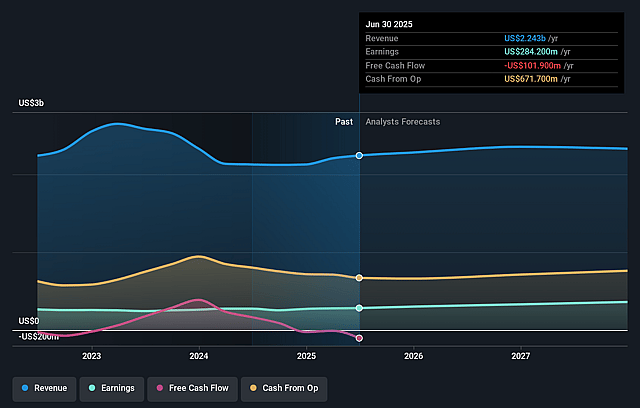
Black Hills Future Earnings and Revenue Growth
Assumptions
How have these above catalysts been quantified?
- Analysts are assuming Black Hills's revenue will grow by 16.8% annually over the next 3 years.
- Analysts assume that profit margins will increase from 12.6% today to 15.9% in 3 years time.
- Analysts expect earnings to reach $578.3 million (and earnings per share of $5.11) by about May 2029, up from $288.3 million today. However, there is a considerable amount of disagreement amongst the analysts with the most bullish expecting $786.0 million in earnings, and the most bearish expecting $415.9 million.
- In order for the above numbers to justify the price target of the analysts, the company would need to trade at a PE ratio of 15.3x on those 2029 earnings, down from 19.2x today. This future PE is lower than the current PE for the US Integrated Utilities industry at 20.2x.
- Analysts expect the number of shares outstanding to grow by 4.5% per year for the next 3 years.
- To value all of this in today's terms, we will use a discount rate of 7.11%, as per the Simply Wall St company report.
Risks
What could happen that would invalidate this narrative?- Heavy capital expenditure requirements for infrastructure projects (e.g., Ready Wyoming transmission expansion, Lange II generation, Colorado Clean Energy Plan) create ongoing pressure on cash flows, and if regulatory recovery lags or costs overrun, this could compress net margins and limit earnings growth.
- Significant projected revenue growth relies on continued ramp-up of large, concentrated, and potentially volatile data center and blockchain load, exposing Black Hills to demand risk if these customers delay, cancel, or reduce commitments, directly impacting revenues and future earnings.
- The company's core dependence on regulated natural gas operations and geographic concentration in the Mountain West and Midwest makes Black Hills vulnerable to asset stranding, tightening emissions regulation, or region-specific economic/demographic stagnation, potentially affecting long-term revenue and net earnings.
- If distributed energy resources (DERs), renewables, and battery storage adoption accelerate more rapidly than Black Hills anticipates, traditional load growth could be undermined, eroding revenue streams and increasing the risk of under-recovery of fixed costs over the long-term.
- Rising frequency and severity of extreme weather events (e.g., wildfires), even with mitigation programs, may drive up insurance premiums, O&M expenses, and reliability investments, pressuring operating costs and potentially reducing net margins over time.
Valuation
How have all the factors above been brought together to estimate a fair value?
- The analysts have a consensus price target of $83.0 for Black Hills based on their expectations of its future earnings growth, profit margins and other risk factors.
- In order for you to agree with the analysts, you'd need to believe that by 2029, revenues will be $3.6 billion, earnings will come to $578.3 million, and it would be trading on a PE ratio of 15.3x, assuming you use a discount rate of 7.1%.
- Given the current share price of $72.84, the analyst price target of $83.0 is 12.2% higher.
- We always encourage you to reach your own conclusions though. So sense check these analyst numbers against your own assumptions and expectations based on your understanding of the business and what you believe is probable.
Have other thoughts on Black Hills?
Create your own narrative on this stock, and estimate its Fair Value using our Valuator tool.
Create NarrativeHow well do narratives help inform your perspective?
Disclaimer
AnalystConsensusTarget is a tool utilizing a Large Language Model (LLM) that ingests data on consensus price targets, forecasted revenue and earnings figures, as well as the transcripts of earnings calls to produce qualitative analysis. The narratives produced by AnalystConsensusTarget are general in nature and are based solely on analyst data and publicly-available material published by the respective companies. These scenarios are not indicative of the company's future performance and are exploratory in nature. Simply Wall St has no position in the company(s) mentioned. Simply Wall St may provide the securities issuer or related entities with website advertising services for a fee, on an arm's length basis. These relationships have no impact on the way we conduct our business, the content we host, or how our content is served to users. The price targets and estimates used are consensus data, and do not constitute a recommendation to buy or sell any stock, and they do not take account of your objectives, or your financial situation. Note that AnalystConsensusTarget's analysis may not factor in the latest price-sensitive company announcements or qualitative material.