

Last Update 05 Aug 26
Fair value Increased 7.99%SCHW: Record Q2 Trading And AI Tools Will Shape Balanced Outlook
For Charles Schwab, the analyst fair value estimate has been raised from about $93.63 to roughly $101.12 as analysts point to higher modeled revenue growth, a slightly lower discount rate, and a series of higher price targets that reflect stronger client activity, new agentic trading opportunities, and updated earnings estimates across recent research.
Analyst Commentary
Recent Street research on Charles Schwab highlights a wide range of opinions on the company, with several firms lifting price targets after Q2 results and updated guidance, while a smaller group of bearish analysts has turned more cautious on valuation, product competitiveness, and longer term growth risks.
On the more constructive side, multiple firms raised price targets following what they describe as strong Q2 results for Charles Schwab. These results included higher client asset levels, record trading volumes, sizable core net new assets, and revenue guidance that sits above prior ranges. Some analysts point to higher trading, lending, and tax-advantaged strategy demand that supports higher earnings estimates and updated long term modeling. Others highlight what they view as solid execution around Schwab's investor day priorities, such as advisor services, workplace solutions, and self-directed trading and wealth offerings.
Several research notes also emphasize the potential role of agentic trading and AI driven functionality at Charles Schwab. One initiation report argues that agentic trading features could help reduce cash sorting pressures by shifting part of the economics from interest income to recurring subscription fees for clients who opt in. Other analysts reference management commentary that positions AI as constructive for the business and as a counterpoint to concerns that AI driven cash optimization tools might pressure Schwab's economics over time.
Alongside these more optimistic views, a number of analysts still describe the stock as sensitive to client cash behavior, interest rate trends, and competitive dynamics across brokerage and wealth. Some express concern that recent trading driven upside in earnings may not reflect what they view as more durable, broad based growth. Others highlight continuing investor focus on potential threats from prediction markets and perpetual futures, particularly as these products see high trading activity and media attention.
Overall, the Street remains engaged on a few core themes for Charles Schwab. These include the sustainability of client engagement and trading volumes, the path of cash sorting and monetization, and the pace of product and technology development around AI and agentic tools. Investor interpretation of these factors, together with valuation and risk tolerance, appears to be driving the split between more bullish and more cautious views.
Bearish Takeaways
- Bearish analysts point to valuation as a key concern after the recent stock rally. One firm downgraded Charles Schwab to a more neutral rating while keeping its US$105 price target unchanged. The firm argues that the risk or reward now looks more balanced even though they view fundamentals as strong.
- Some bearish analysts see structural pressure from what they describe as an increasingly less competitive product offering and demographic headwinds. Even as they raise long dated EPS estimates and move their price target to US$91 from US$86, they maintain a cautious stance on execution risk and future growth.
- Certain research highlights ongoing worries about cash monetization and sorting. One bearish group explicitly states that they do not expect the overhang from cash monetization fears to ease soon and that, while revenue diversification could help, they see timing risk and execution uncertainty around new initiatives.
- A few cautious notes flag the possibility that recent earnings strength is too reliant on trading and options activity rather than what they consider core, repeatable drivers. They also call out increased investor focus on prediction markets and perpetual futures as an emerging competitive threat that could create pressure on Schwab's growth path if client behavior shifts.
What’s in the News for Charles Schwab
- Charles Schwab reported record Q2 revenue of US$7.1b and earnings of US$1.62 per share, which were above Wall Street estimates, with client assets at US$13.08t and a 28% rise in trading revenue tied to higher trading volumes. Source: recent earnings coverage.
- The company launched direct Bitcoin and Ethereum trading for retail investors alongside its Q2 report, expanding its digital asset offering. Source: recent earnings coverage.
- Despite the record quarter and higher full year 2026 revenue guidance, Charles Schwab stock declined 2.5% after the earnings release. Source: recent earnings coverage.
- Filings show Charles Schwab managed some of Donald Trump’s investment accounts in 2025, with Schwab cited as the most involved by dollar value and trading activity, which raised discussion about compliance and reputational risk for institutions handling these assets. Source: media reporting on Trump financial disclosure.
- From April 1, 2026 to June 30, 2026, Charles Schwab repurchased 11,200,000 shares for US$1,000m, bringing total buybacks under the current program to 93,564,000 shares, or 5.25%, for US$8,871.17m.
Valuation Changes for Charles Schwab
- Fair Value has risen from about $93.63 to roughly $101.12, which is an increase of around 8% in the analyst model for Charles Schwab.
- Discount Rate has fallen slightly from 8.51% to about 8.12%, implying a modest shift in the modeled risk profile.
- Revenue Growth has been revised higher from about 5.70% to roughly 9.85%, reflecting a meaningfully faster expected top line expansion in the updated assumptions for revenue in dollars.
- Net Profit Margin has been trimmed from around 43.38% to about 40.65%, indicating lower modeled profitability even as revenue growth assumptions move higher.
- Future P/E has edged down from roughly 14.39x to about 13.80x, which points to a slightly lower earnings multiple in the updated valuation work.
Catalysts
About Charles Schwab
Charles Schwab is a diversified financial services firm providing brokerage, wealth management, banking and advisory solutions to individual investors and independent advisers.
What are the underlying business or industry changes driving this perspective?
- Heavy investment in AI, technology and new platforms such as spot crypto could overshoot sustainable demand. This may lead to structurally higher run-rate technology and personnel spending that compresses operating leverage and erodes pretax margins, even if revenues keep growing.
- Record equity markets, elevated trading volumes and peak margin balances risk reversing as rates fall and volatility normalizes. This could simultaneously reduce net interest revenue, trading revenue and securities lending income, putting pressure on top line growth and earnings.
- Greater reliance on pledged asset lines, margin lending and bank lending to drive growth increases credit and interest rate risk. A downturn or policy shift could slow loan demand, raise loss provisions and materially weaken net interest margin and net income.
- Rapid growth among younger, more digitally native and trading-oriented clients may skew revenue toward cyclical trading and lower-yield cash balances, while requiring sustained content and service investment. This may create a mix shift that limits fee growth and dampens long-term net margins.
- Strategic balance sheet repositioning from high-cost wholesale funding toward new securities and flexible BDA usage may lock in lower yields if the rate-cut path accelerates. This could cap future net interest income growth and constrain earnings expansion despite robust client asset growth.
Assumptions
How have these above catalysts been quantified?
- This narrative explores a more pessimistic perspective on Charles Schwab compared to the consensus, based on a Fair Value that aligns with the bearish cohort of analysts.
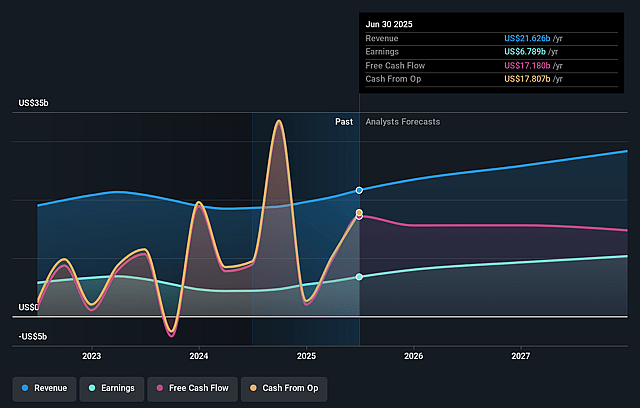
- The bearish analysts are assuming Charles Schwab's revenue will grow by 9.9% annually over the next 3 years.
- The bearish analysts assume that profit margins will increase from 37.4% today to 40.6% in 3 years time.
- The bearish analysts expect earnings to reach $14.0 billion (and earnings per share of $8.06) by about August 2029, up from $9.7 billion today. However, there is some disagreement amongst the analysts with the more bullish ones expecting earnings as high as $15.5 billion.
- In order for the above numbers to justify the price target of the more bearish analyst cohort, the company would need to trade at a PE ratio of 13.8x on those 2029 earnings, down from 19.0x today. This future PE is lower than the current PE for the US Capital Markets industry at 38.3x.
- The bearish analysts expect the number of shares outstanding to decline by 4.42% per year for the next 3 years.
- To value all of this in today's terms, we will use a discount rate of 8.12%, as per the Simply Wall St company report.
Risks
What could happen that would invalidate this narrative?
- Sustained client asset growth, including $11.59 trillion of client assets and nearly $356 billion of core net new assets year to date, suggests Schwab may continue to compound its asset base through cycles. This could support long term revenue and earnings growth rather than a structural decline in the share price.
- Secular tailwinds from younger, highly engaged investors, with roughly one third of new to firm retail households coming from Gen Z and a growing share of under 40s using Schwab for financial planning, could underpin durable volume, fee and lending growth that bolsters long term revenue and net margins.
- Ongoing mix shift into higher value wealth, lending and advisory solutions, including record Schwab Wealth Advisory flows, 24% growth in bank lending and 37% growth in pledged asset line balances, may structurally enhance profitability and capital efficiency. This may support resilient net interest income and pretax margins.
- Strategic investments in scale and efficiency, such as AI enabled service tools, expanded digital capabilities and balance sheet optimization, are designed to keep cost to serve low and operating leverage high. This could sustain strong pretax margins and earnings growth even if market conditions soften.
Valuation
How have all the factors above been brought together to estimate a fair value?
- The assumed bearish price target for Charles Schwab is $101.12, which represents up to two standard deviations below the consensus price target of $125.0. This valuation is based on what can be assumed as the expectations of Charles Schwab's future earnings growth, profit margins and other risk factors from analysts on the more bearish end of the spectrum.
- However, there is a degree of disagreement amongst analysts, with the most bullish reporting a price target of $145.0, and the most bearish reporting a price target of just $91.0.
- In order for you to agree with the more bearish analyst cohort, you'd need to believe that by 2029, revenues will be $34.5 billion, earnings will come to $14.0 billion, and it would be trading on a PE ratio of 13.8x, assuming you use a discount rate of 8.1%.
- Given the current share price of $106.35, the analyst price target of $101.12 is 5.2% lower. The relatively low difference between the current share price and the analyst consensus price target indicates that they believe on average, the company is fairly priced.
- We always encourage you to reach your own conclusions though. So sense check these analyst numbers against your own assumptions and expectations based on your understanding of the business and what you believe is probable.
Have other thoughts on Charles Schwab?
Create your own narrative on this stock, and estimate its Fair Value using our Valuator tool.
Create NarrativeHow well do narratives help inform your perspective?
Comments
0 commentsDisclaimer
AnalystLowTarget is a tool utilizing a Large Language Model (LLM) that ingests data on consensus price targets, forecasted revenue and earnings figures, as well as the transcripts of earnings calls to produce qualitative analysis. The narratives produced by AnalystLowTarget are general in nature and are based solely on analyst data and publicly-available material published by the respective companies. These scenarios are not indicative of the company's future performance and are exploratory in nature. Simply Wall St has no position in the company(s) mentioned. Simply Wall St may provide the securities issuer or related entities with website advertising services for a fee, on an arm's length basis. These relationships have no impact on the way we conduct our business, the content we host, or how our content is served to users. The price targets and estimates used are consensus data, and do not constitute a recommendation to buy or sell any stock, and they do not take account of your objectives, or your financial situation. Note that AnalystLowTarget's analysis may not factor in the latest price-sensitive company announcements or qualitative material.


