

Last Update 01 Jul 26
Fair value Increased 28%FDX: Freight Spin And Calendar Shift Will Pressure Network 2.0 Execution
FedEx's updated fair value estimate has moved from $173.62 to $221.61 as analysts recalibrate price targets. They cite the Freight spin-off, the shift to calendar-year reporting, and ongoing Network 2.0 and cost discipline efforts as key drivers of their revised models.
Analyst Commentary
Recent research on FedEx reflects a mixed backdrop, with most firms revisiting their models after the Freight spin and the switch to calendar-year reporting. While several large banks maintain constructive views on the core parcel business and cost programs such as Network 2.0 and DRIVE, others are leaning more cautious as they reassess earnings power, execution risks and how to value the post-spin structure.
On the more constructive side, JPMorgan upgraded FedEx to Overweight with a US$460 price target, highlighting what it views as attractive risk or reward into the separation of the freight business and citing structural improvements at the remaining Federal Express operations. Other large firms maintain positive stances tied to cost discipline, tighter capex oversight and a focus on shareholder returns through buybacks and dividends.
Several research notes emphasize that FedEx is now more clearly oriented around the parcel business, with Express and Ground moving under the Network 2.0 framework. Analysts point to ongoing efforts to manage incentives, refine capital allocation and pursue margin improvement as central themes for how investors may reassess the stock as the new reporting structure beds in.
At the same time, the Freight spin and the transition to calendar-year financials are creating a period of noisy comparisons. Guidance around calendar 2026 and 2027 earnings per share targets, as well as the seasonality of the June to December transition period, are key inputs into revised fair value work across the Street and are influencing how quickly some analysts are willing to underwrite higher earnings trajectories.
Overall, the latest FedEx commentary frames a company in the middle of a complex reset. Investors are being asked to weigh cost savings and capital return against questions around freight separation, disclosure timing and the durability of profitability targets under the new structure.
Bearish Takeaways
- Several Bearish analysts have reduced FedEx price targets sharply, including moves from US$410 to US$340 and from US$230 to US$160, reflecting concerns that current valuation already embeds ambitious expectations for transformation and cost savings.
- Some Bearish analysts highlight execution risk as FedEx manages the concurrent Freight spin, the integration of Express and Ground, and a fiscal year shift. They argue that near term earnings and margins could be harder to interpret and may fall short of more optimistic targets.
- Cautious research flags uncertainty around full standalone visibility into the Parcel and Freight businesses, with one Bearish analyst expecting limited clarity until late October. This could limit conviction on growth and margin assumptions during the transition window.
- Where forecasts point to earnings coming in modestly below consensus, Bearish analysts warn that any disappointment versus expectations, combined with recent volatility around guidance, could pressure the stock if investors reassess what they are willing to pay for FedEx’s long term growth story.
What’s in the News for FedEx
- FedEx reported fiscal Q4 2026 adjusted EPS of $6.31 on revenue of $25.01b, both above consensus, in its final quarter including the Freight business before the June 1 spin off, yet the stock fell about 5 to 6% in after hours trading as fiscal 2027 earnings guidance came in below Wall Street expectations. (Source: FedEx Beats Q4 Earnings and Revenue Estimates Amid Freight Spin Off, Shares Fall on Lower Fiscal 2027 Guidance)
- The company completed the spin off of FedEx Freight, which is now a separate publicly traded less than truckload operator, issued its own revenue growth and margin guidance for a seven month transition period, and contributed a $4.1b cash dividend that FedEx is using in part to reduce debt. (Sources: FedEx Beats Q4 Earnings and Revenue Estimates Amid Freight Spin Off, Shares Fall on Lower Fiscal 2027 Guidance; FedEx Completes Spin Off of FedEx Freight, Projects Revenue Growth Despite Q4 Margin Pressure)
- FedEx updated guidance for calendar 2026, forecasting revenue growth of about 11% year on year and diluted EPS from continuing operations of $16.55 to $17.75, while analysts focused on how this guidance compares with prior expectations and the effects of the new reporting structure. (Sources: FedEx Beats Q4 Earnings and Revenue Estimates Amid Freight Spin Off, Shares Fall on Lower Fiscal 2027 Guidance; Corporate Guidance Key Development)
- Pilots at FedEx, represented by the Air Line Pilots Association, ratified a new four year contract with nearly a 40% hourly pay increase, back pay, and updated work rules, and the board approved a 5% increase in the annual dividend rate to $4.88 following the Freight spin off. (Sources: FedEx Pilots Ratify New 4 Year Contract with 40% Pay Increase, Ending Protracted Negotiations; Dividend Key Development)
- FedEx announced several partnership moves, including a strategic agreement with Viettel Post to act as its National Network Provider in Vietnam and a memorandum of understanding with China Southern Air Logistics to deepen Asia Pacific air cargo cooperation, while also working with ServiceNow to embed FedEx Dataworks intelligence into supply chain workflows. (Sources: FedEx Partners with China Southern Air Logistics to Expand Asia Pacific Cargo Network and Restores Vietnam Operations; Viettel Post Client Announcement Key Development; Strategic Alliances Key Development)
Valuation Changes for FedEx
- Fair Value: revised from $173.62 to $221.61, a rise of about 28% in the updated model for FedEx.
- Discount Rate: adjusted slightly higher from 8.77% to 8.81%, indicating a modest change in the assumed risk profile.
- Revenue Growth: reduced from 1.24% to 0.27%, implying a more conservative outlook for top line expansion in the model.
- Net Profit Margin: moved from 5.54% to 5.38%, reflecting a small step down in assumed profitability.
- Future P/E: increased from 10.40x to 14.21x, signalling a higher valuation multiple applied to FedEx in the updated assessment.
Key Takeaways
- Structural declines in parcel volumes, rising labor and environmental costs, and intensifying price competition threaten long-term revenue growth and margin sustainability.
- Underperformance in international markets and challenges from e-commerce giants could significantly limit global expansion and erode pricing power.
- Structural cost reductions, e-commerce parcel growth, market share gains, and disciplined capital allocation position FedEx for stronger margins, earnings, and shareholder value.
Catalysts
About FedEx- Provides transportation, e-commerce, and business services in the United States and internationally.
- The rapid acceleration of digitalization and automation across key industries is likely to reduce the overall need for physical shipments, as virtual goods and services increasingly replace physical ones. This structural change could lead to steadily declining parcel volumes over time, putting sustained pressure on FedEx's long-term revenue growth.
- Mounting regulatory pressure related to decarbonization-including stricter environmental standards and emissions targets-is expected to drive a substantial increase in operational costs and capital expenditures for FedEx. Investments required to upgrade fleets, implement carbon-efficient logistics, and comply with global regulations threaten to erode net margins and depress future earnings.
- Persistent labor cost inflation, ongoing unionization risks, and associated wage pressures-highlighted by the company's own acknowledgment that wage inflation is not going away-are likely to further compress net margins. FedEx's heavy reliance on a large, distributed workforce makes it especially vulnerable to these long-term cost increases.
- FedEx continues to underperform international competitors in critical overseas markets, with ongoing challenges in Asia and Europe. This trend, combined with the onshoring and reshoring of supply chains that cut into lucrative international long-haul business, is poised to limit future global revenue growth and overall margin expansion even as domestic diversification efforts face intensifying cost headwinds.
- The ongoing rise of integrated e-commerce giants like Amazon, low-cost regional carriers, and disintermediation by shippers building their own logistics networks will likely intensify price competition and reduce industry-wide yields. This will structurally challenge both FedEx's pricing power and its ability to sustain volume growth, putting further downward pressure on future earnings and returns.
FedEx Future Earnings and Revenue Growth
Assumptions
How have these above catalysts been quantified?
- This narrative explores a more pessimistic perspective on FedEx compared to the consensus, based on a Fair Value that aligns with the bearish cohort of analysts.
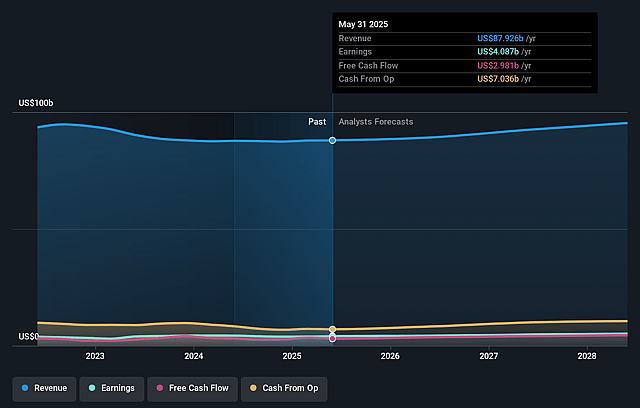
- The bearish analysts are assuming FedEx's revenue will remain fairly flat over the next 3 years.
- The bearish analysts assume that profit margins will increase from 4.7% today to 5.4% in 3 years time.
- The bearish analysts expect earnings to reach $5.1 billion (and earnings per share of $23.01) by about July 2029, up from $4.4 billion today. However, there is some disagreement amongst the analysts with the more bullish ones expecting earnings as high as $5.8 billion.
- In order for the above numbers to justify the price target of the more bearish analyst cohort, the company would need to trade at a PE ratio of 14.3x on those 2029 earnings, down from 16.9x today. This future PE is lower than the current PE for the US Logistics industry at 16.9x.
- The bearish analysts expect the number of shares outstanding to grow by 2.16% per year for the next 3 years.
- To value all of this in today's terms, we will use a discount rate of 8.81%, as per the Simply Wall St company report.
Risks
What could happen that would invalidate this narrative?- FedEx's ongoing DRIVE initiative and network transformation projects such as Network 2.0 and Tricolor are systematically reducing its structural costs, which can lead to higher operating margins and improved earnings even in a challenging demand environment.
- The company is experiencing steady parcel volume growth driven by e-commerce and deferred services, with initiatives like expanded Sunday residential coverage and wins in high-margin verticals (e.g., health care), supporting potential long-term revenue growth.
- FedEx is gaining market share in both U.S. and international parcel and airfreight segments, aided by strong service levels, productive sales strategies targeting small, medium, and bundled customers, and share gains in Europe despite a weak economic climate; these trends can lead to higher revenues and robust earnings once the macro environment improves.
- The modernization and optimization of FedEx's air fleet, including the acquisition of fuel-efficient Boeing 777s and retirement of older MD-11s, are expected to improve asset utilization and manage capital expenditures efficiently, supporting free cash flow and return on invested capital.
- Strategic capital allocation, disciplined cost management, and substantial share repurchases-alongside the anticipated benefits of the tax-efficient Freight spin-off-are likely to increase shareholder value through enhanced earnings per share and higher returns, even amid flat or moderate revenue growth.
Valuation
How have all the factors above been brought together to estimate a fair value?
- The assumed bearish price target for FedEx is $221.61, which represents up to two standard deviations below the consensus price target of $349.72. This valuation is based on what can be assumed as the expectations of FedEx's future earnings growth, profit margins and other risk factors from analysts on the more bearish end of the spectrum.
- However, there is a degree of disagreement amongst analysts, with the most bullish reporting a price target of $479.0, and the most bearish reporting a price target of just $160.0.
- In order for you to agree with the more bearish analyst cohort, you'd need to believe that by 2029, revenues will be $95.5 billion, earnings will come to $5.1 billion, and it would be trading on a PE ratio of 14.3x, assuming you use a discount rate of 8.8%.
- Given the current share price of $313.13, the analyst price target of $221.61 is 41.3% lower. Despite analysts expecting the underlying business to improve, they seem to believe the market's expectations are too high.
- We always encourage you to reach your own conclusions though. So sense check these analyst numbers against your own assumptions and expectations based on your understanding of the business and what you believe is probable.
Have other thoughts on FedEx?
Create your own narrative on this stock, and estimate its Fair Value using our Valuator tool.
Create NarrativeHow well do narratives help inform your perspective?
Disclaimer
AnalystLowTarget is a tool utilizing a Large Language Model (LLM) that ingests data on consensus price targets, forecasted revenue and earnings figures, as well as the transcripts of earnings calls to produce qualitative analysis. The narratives produced by AnalystLowTarget are general in nature and are based solely on analyst data and publicly-available material published by the respective companies. These scenarios are not indicative of the company's future performance and are exploratory in nature. Simply Wall St has no position in the company(s) mentioned. Simply Wall St may provide the securities issuer or related entities with website advertising services for a fee, on an arm's length basis. These relationships have no impact on the way we conduct our business, the content we host, or how our content is served to users. The price targets and estimates used are consensus data, and do not constitute a recommendation to buy or sell any stock, and they do not take account of your objectives, or your financial situation. Note that AnalystLowTarget's analysis may not factor in the latest price-sensitive company announcements or qualitative material.


